14 November 2012

Qatar Airways, the launch customer, will convert #20 A350-800s into bigger A350 XWB

For second time in few days, another A350-800 customer has decided to convert their orders to bigger A350 version. But this time is not just “another customer”. Al Baker´s Qatar Airways was the launch customer of A350-800 and also it is the first customer for A350-900 and A350-1000 version.
Qatar Airways has shifted its order for 20 Airbus A350-800s to the larger -900 variant. It will be confirmed in coming days.
Speaking at a Doha press conference after the arrival of the carrier's first Boeing 787,Qatar Airways chief executive Akbar Al Baker confirmed that it had ditched its A350-800s. Its order book for the type now comprises #60 -900s and #20 -1000s and it remains the launch customer for both variants.
 The Qatar Airways decision leaves Airbus with a shrinking backlog for the smallest A350 variant -stands at #92 firm orders-, raising questions about whether it’ll stick with the model. Airbus has already seen several customers (around 40%) swap A350-800 orders for larger variants, most recently Afriqiyah Airways.
 This is in line with market trend, upsizing to larger models,” Marcella Muratore, a spokeswoman for Airbus, said today in an interview. Muratore said she had no information to provide on which of the larger variants Qatar will take, but she said Airbus remains committed to building the A350-800.

It is not a surprise as Airbus is moving in this direction since some months ago investing in an improve program for the A330 (announced in Farnborough in July/2012).
Airbus could probably save at least 1 billion euros ($1.27 billion) by dropping the smallest model and concentrating its engineering resources on developing the bigger and more expensive A350-1000, said Nick Cunningham, managing partner at Agency Partners in London.
“After this move by Qatar, that’s not looking like a launch for what is an expensive program,” said Cunningham. “It would seem logical to me for them to drop the -800 and focus on the -1000. That would free up engineering capacity and take costs out.”
But the next movement is not clear; A350-800 could be cancelled, could be postponed or could be maintained. It will depend on future decision in the higher range of the family, with 787-10X and 777X by Boeing and a possible A350-1100 version, as the wide body market continue growing in quantity and in size. We shoul maintained tunned to Qatar next steps.

Based on the article “Qatar drops A350-800 for larger -900” published in FlightGlobal and “Qatar Airways Swaps Airbus Smallest A350 for Larger Variants” published in Bloomberg.

13 November 2012

Spirit AeroSystems CEO "extremely disappointed" in their management of the complexity on new programs, included A350 XWB


During the presentation of the Third Quarter 2012 Financial Results on 1st November, Spirit AeroSystems CEO Jeff Turner stated: “As demonstrated by the third quarter results, our core programs are performing well and we are financially healthy.”

“While new airplane programs are always challenging, I am extremely disappointed in our management of the complexity on these programs. We have struggled with the development and early production on certain programs as highlighted by the charges in the quarter. However, it is important to note that as these programs are now transitioning to full rate production and experiencing rate increases we are applying our lessons learned and focusing on driving operational performance and cost improvement into these programs,” Turner continued.


As a summary, Spirit AeroSystems reported third quarter 2012 financial results reflecting continued strong demand for large commercial aircraft, solid core program operating performance, the impact of new program charges, and the final insurance settlement for claims relating to the April 14, 2012 severe weather event at its Wichita, Kan. facility. Spirit’s third quarter 2012 revenues were $1.365 billion, up 21% from $1.130 billion for the same period of 2011, driven by higher production volumes.

“Strong market demand for our products continues as large commercial aircraft deliveries increased 7%  and deliveries across all programs increased 12% over the third quarter of 2011,” said President and Chief Executive Officer Jeff Turner.

The current quarter compared to the same period of 2011 includes an additional $50 million customer advance associated with a customer agreement on the A350 fuselage program, partially offset by the timing of accounts receivable and accounts payable.
 The complex section 15 centre fuselage, produced by Spirit AeroSystems, is one of the critical components. It was the source of concern for MSN5000 Static Test specimen and MSN001. And remains identified as critical; Didier Evrard "can't say everything is fully bridged" regarding the production process. Spirit AeroSystems Inc., the largest U.S. supplier for the A350 structure is still working to produce parts of the plane more efficiently, said chief executive Jeff Turner in an interview. “It’s not going as well as I’d like,” he said. Spirit and Airbus have said they are cooperating to meet ambitious production targets for the plane.
·         Fuselage composite panels fabrication in AFP
·         transport corridor (AGV) for Fuselage panels
·         detail assembly bay for Fuselage panels
·         frame shop
·         trim and inspection (with Torressonic)
·         Spar composite fabrication

12 November 2012

Libya's Afriqiyah Airways converts A350-800 into A350-900 and orders #4 additional aircraft

 Airbus has waited till French foreign minister Laurent Fabius is in Libya -where he is meeting with President Mohamed Megarief and Prime Minister-elect Ali Zeidan- to announce that one month ago, Libyan carrier Afriqiyah Airways converted its previous order for #6 A350-800s into orders for the larger A350-900. And also Afriqiyah Airways ordered another #4 A350-900, bringing its total order to #10 aircraft.

Airbus is pushing airlines to convert A350-800 orders to larger A350-900.
As per Airbus´ press release, these aircraft will be operated on new routes the carrier will open to destinations in the US, the Middle East and Asia.

“Having Afriqiyah come back with this new, incremental order for the A350 XWB is great news and a strong signal that this aircraft is the industry’s new benchmark in the long-haul segment,” said John Leahy, Airbus Chief Operating Officer, Customers. “We are convinced that the A350’s unbeatable economics and superior passenger comfort will be key contributors to Afriqiyah’s continued success.”
 the number 9.9.99 refers to the birth date (September 9, 1999) of the African Union

Based on Airbus´ press release “Afriqiyah Airways places firm order for four more A350 XWBs”

11 November 2012

A380 Test bend with Trent XWB: stop-show-go for R-R staff at Derby

 The A380 test bend made a two-day break in their test schedule (on it´s way to get the certificate of airworthiness allowing it to be used on the A350 XWB) to allow Rolls-Royce staff to see the fruits of their labours up close. The event, specially organized by Rolls-Royce and Airbus to thank to 2,000 Rolls-Royce staff in Derby who have worked on the XWB engine program, took place in East Midlands Airport.

About 650 of those workers were taken to the airport to see the engine on the wing and have a tour of the A380 test plane.

Andy Knox, head of production readiness for the XWB said: "It was a proud moment for us and for Derby to see the A380 and the XWB at East Midlands Airport. We have a very busy production schedule ahead of us over the next few years. When production really ramps up we will be making one of these engines a day. The company has invested a lot of money in this engine. It has also spent large sums making sure the Derby site is ready for production. It's a great privilege to work on this project. We're absolutely delighted with the number of orders we have received so far and we are looking forward to the engine getting all of its certification and then getting on with the job of making them in big numbers."


A group of pupils from Gayton Junior School, in Littleover, had a tour to see the XWB engine and the A380.

Chris Orchard, a project development engineer for the XWB, said: "To actually see the engine on the wing, in the flesh, was quite an emotional experience. A lot of people have devoted years of their lives to this project. So, days like this are very special. The engine itself is amazing – and not just to look at. It is the most efficient large gas turbine engine ever built. That probably explains why so many customers have ordered them."


Peter Chandler, chief test pilot at Airbus said: "The XWB is performing well. Although the XWB is designed specifically for the A350 aircraft, it is possible to test the engine on an A380. The XWB produces around 10,000lbs more thrust that the Trent 900, so you can feel a bit more of a pull on one side but it something that can be managed. The XWB is being put through its paces in different environments. We were recently near Dubai carrying out hot-weather testing. It will soon be going to Siberia to do some cold weather testing. I haven't put my name down for that!" 
Based on the article "Touchdown for engine which will take R-R to new heights” published in Derby Telegraph.

10 November 2012

Ramp up crucial to have a rate of 10 aircraft per month when the first A350-1000 is produced

During FAL inauguration, Mr.Evrard pointed out that at least the first two flight-test aircraft will be kept at Airbus and no decision has been made whether to keep MSN2 and MSN4, the subsequent aircraft. Airbus plans to assemble two aircraft this year and start producing a third before year-end.

In the second half of 2013, it will aim for a production rate of one aircraft per month. “Ramping up production will be crucial,” Evrard says.

The ramp-up required by Airbus is to produce 10 aircraft per month when the first A350-1000 is delivered, more or less between MSN50 and MSN60 (in 2017).

Suppliers have noted with concern two issues surrounding the program:
-Airbus's decision to introduce weight improvements and changes in several batches, which leads to extra work and some performance shortfalls for early models, and
- the recent wing-drilling troubles that have led to delays for later aircraft, although not for MSN1. A350 program chief Didier Evrard told suppliers that introducing the aircraft in batches is a normal process.
Image courtesy of FlightGlobal
Some issues that have historically caused trouble in programs such as the A340-600 or the A380 will only become relevant next year; cabin installation is one such area, and suppliers are already scrambling to make specification changes on time to meet targets mostly related to weight reduction.

09 November 2012

No fixed order for A350 XWB from any of European legacy airlines yet. British Airways, Iberia, Air France and Lufthansa making serious cuts to survive.

4 Nations A350 XWB workshare and financial support has nothing to be with orders from main national legacy airliners.

Let´s see how main national airlines from Airbus #4 nations are supporting the A350 XWB program with orders; Lufthansa, Air France, British Airways and Iberia. Government assistance will be needed, as USA makes with Boeing.
Europe's four legacy airlines are making serious cuts to stem mounting losses, but it will be a very long time before they are remotely near the healthy profit margins of 4-5 years ago.


British Airways has orders for #12 A380 and the rest of the fleet of Boeing 777, 787 and 747. No A330/A340. No order for A350 expected but for 787-10X.
International Airlines Group (IAG) unit British Airways is currently in advanced discussions with Boeing for an order of up to #60 Boeing 787-10X Dreamliners to replace all of its 777-200ERs and to expand British’s international network in Asia, as per Aspire Aviation‘s information. Also they are assessing A350-1000 for 747 replacement.
British Airways currently has 52 Boeing 777 aircraft in its fleet, with #4 additional ordered. It has also orders for #8 787-8 and #16 787-9.  


Iberia has full Airbus long-haul fleet with #42 A330/A340 and no Boeing aircraft. No orders for A350 as of today.
The loss-making Spanish unit of IAG could receive the 787s ordered by British (#8+#16) Iberia to tap into soaring air travel demand in South America.
Iberia's management is working on a large-scale restructuring plan to stave mounting red ink. Substantial capacity cuts are planned with 4.500 job cuts and 4-engine A340 fleet withdrawal. The downsizing will affect short-haul runs and long-haul flying to Latin America with global figures of 15% network downsize. Some months ago it was created its short-haul affiliate, Iberia Express.

 Air France has a long-haul fleet of #66 B777 and #28 A330/A340. Additionally, #12 A380. It has a MOU for #25 A350 since one year that has not been converted in a firm order yet.
Transform 2015 restructuring plan aims to improve efficiency by 20% to save €2 billion annually. The passengers business is split into 3 divisions; long-haul, the Paris Charles de Gaulle-based medium-haul routes, and a unit that covers Paris Orly and the regional airports. “Each of the business units must optimize the economic performance of its scope of activity,” Air France states.
Air France-KLM has already eliminated 5,000 jobs and there are plans for additional 1,300 job cuts.


Lufthansa, has a splitted long-haul fleet with #68 A330/A340, #10 A380 and #27 747 plus #16 747-8i orders from Boeing. No orders for A350 as of today.
Lufthansa is taking more drastic steps in its Score reorganization plan; they are transferring to its lower-cost subsidiary, Germanwings all point-to-point activities except long-haul and hub-and-spoke routes that will remain with Lufthansa. Lufthansa has delayed an upgrade of the inter-continental plane fleet.
Lufthansa is seeking to unify standards for engines and cockpits across its group of five airlines to boost purchasing power; the aim is to find a common denominator to place one single order and negotiate more favorable terms and conditions for aircraft, including the Airbus A320neo family, Bombardier CSeries, the Boeing 787 or the A350. In its long-haul fleet, Luthansa will pare down its 6 aircraft types -in 16 different versions- to 4 aircraft versions.

“Our European operations have been taking substantial losses for a number of years. We are also seeing prices fall on long-haul routes,” Lufthansa CEO Christoph Franz says.
Lufthansa is cutting 3,500 administrative posts and as many as 1,000 in catering.


Long-haul operations (where the market of A350 XWB is) are under structural changes with the recent links forged by Qatar Airways/Oneworld, Etihad/Air France-KLM and Emirates/Qantas Airways. It is the way the Airliners have found to face the sluggish economy,  the persistently high oil prices (jumping 15% per quarter) and the cargo traffic fell, hurt by the economy and industry overcapacity.

[corrected and updated]
  
Based on article “Lufthansa to unify standards on future aircraft orders” published in ATW
Based on article "Europe's legacy airlines are trying to revamp short-haul flying" published in Aviation Week
Based on article "British Airways Proceeding With Replacement of Biggest 747 Fleet"    published in Blommberg
Based on article “Air France, Lufthansa Earnings Trump Estimates on Cost Cuts” published in Blommberg

07 November 2012

...and the “Hallo-wing” arrived as scheduled, allowing MSN001 wing-join up.

Airbus has released today the photo below in the new dedicated web to demonstrate the MSN001 final assembly is progressing as scheduled. The wings are being attached to the fuselage and other finishing activities -such as the spoilers- are being also installed. The wing root joint is an already demonstrated process in the Static Specimen and no special issues are expected. But the work in the FAL is intense, also during the night as can be appreciated in the photo.

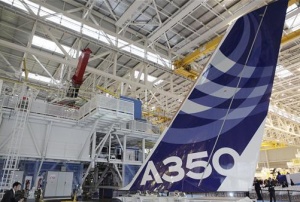
After the wing /fuselage junction, the Horizontal & Vertical stabilizers will be installed in following days or weeks in November. The full aircraft power-on is expected before end of the year.

 Meanwhile, the Static Specimen MSN5000 will be moved to another site in Toulouse airport (the photos and videos of this “roll-out” will be show all around the world, for sure) to prepare for the Static tests start in 2013.