19 September 2015

Airbus has finally delivered the 6th A350. MSN15 to Vietnam Airlines.


Source: Jujug Spotting


The last A350 delivered was on 30/June to Vietnam Airlines (MSN14) and after nearly 2 months and a half without deliveries, finally today Airbus has delivered the MSN15 again to Vietnam Airlines.


Source: Khanna-Prade


VN-A887 is the final registration of this aircraft that had the roll-out on 13/July and the first flight on 31/July.


Source: A380_TLS_A350


The MSN8 for launch customer Qatar Airways will be delivered in coming days after some weeks of delay. MSN11 for Qatar and MSN15 for Finnair could be delivered before.

Source: Clement Alloing


This is the 2nd aircraft delivered to Vietnam Airlines and the 6th A350 delivered to Customers.


18 September 2015

First A350-1000 fuselage sections´ manufacturing on track.


The section-19 for MSN59 has been completed and delivered to Germany.

Source: Airbus
 

The tail cone is manufactured in Spain; the lateral shells at Illescas composite site and later the assembly is completed at Getafe site.
 

The Section 19 is later shipped from Getafe to Hamburg for build up with the Section 16-18 panels.


Source: Premium AEROTEC
 

On the same date, Premium AEROTEC's Nordenham site handed over the complete front fuselage section for the same 1st A350-1000.


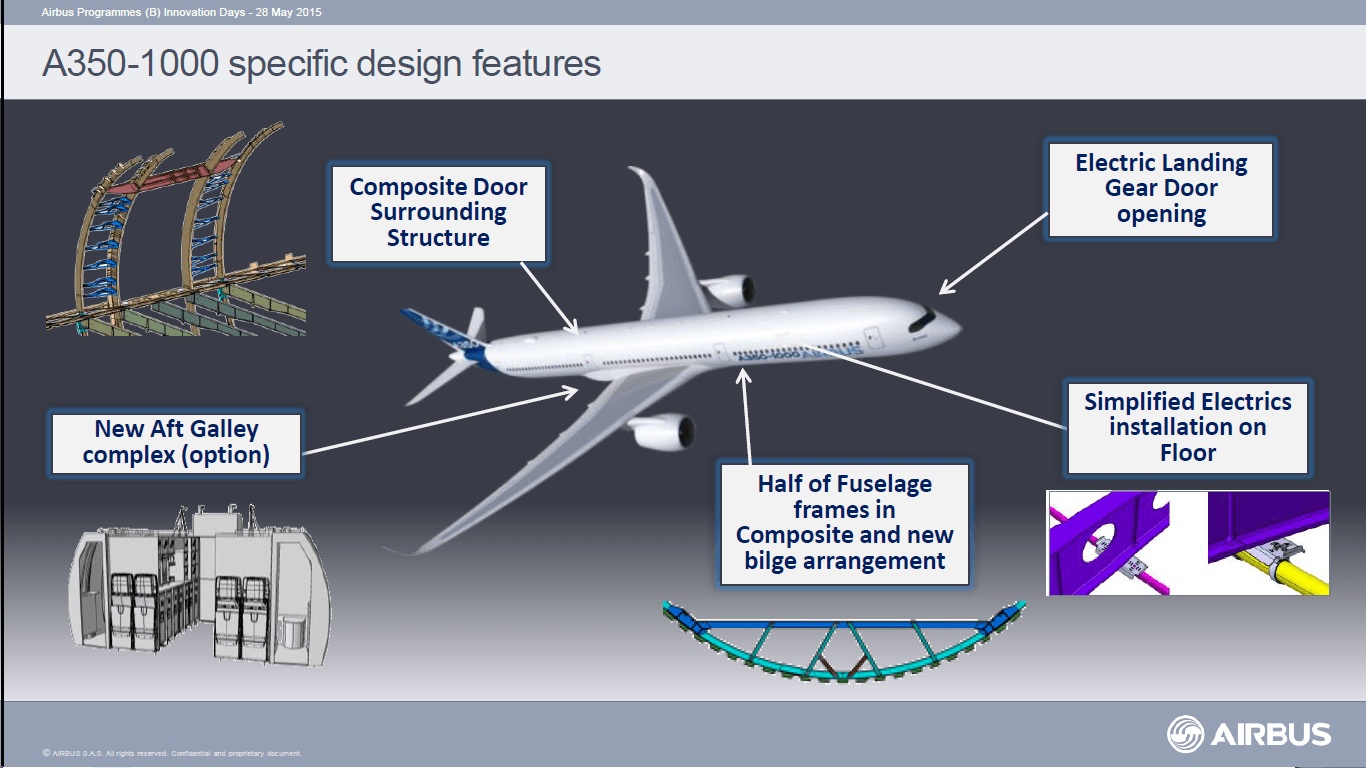
This fuselage section will be completed by a CFRP door frame, bringing significant savings in weight and costs.

Delivery of the rear fuselage section from Augsburg is scheduled for the end of September.
 

Source: Lindner Fotografie
 

During the ceremony at Nordenham, Daniel Wenninger, Program Head at Airbus for the front and rear fuselage of the A350-1000, said: "In addition to higher loads and the use of new structural technologies, the over 3-metres longer fuselage section for the -1000 made considerable modifications in the design and construction necessary compared to its sister model A350-900. "


"The team managed to devise a first-class design for this highly complex aircraft component and to deliver it on time and in the desired high quality. That is something they can be proud of."

 
Based on the press release “Premium AEROTEC übergibt erste vordere CFK-Rumpfsektion für A350-1000”

17 September 2015

Philippine Airlines Nears 787 or A350 choice.

Philippine Airlines (PAL) is on track to make a decision by the end of 2015 regarding whether it will order Boeing 787s or Airbus A350s to replace its A340 fleet.


The airline has received proposals from both manufacturers and is still conducting its evaluation, said PAL President Jaime Bautista.

The management team hopes to make a recommendation to the board within the next few months, and then the board will make the final decision.

Source: Lindner Fotografie


PAL may order 8 aircraft, Bautista said.

These would replace the 6 A340-300s in the fleet and also provide for some fleet growth.
The new aircraft would provide the carrier with the opportunity to fly new nonstop sectors, such as Manila-New York.

The versions being considered by the carrier are the Boeing 787-9 and the Airbus A350-900.

Source: Lindner Fotografie


Whichever aircraft type is selected will be configured with less than 300 seats, including economy, premium economy and business class. The A340s currently have a 254-seat, two-class layout.

Bautista noted that 787s and A350s have both greater fuel-efficiency and lower maintenance costs.

Based on the article “Philippine Airlines Nears 787/A350 Choice” published in Aviation Week.

16 September 2015

Design changes to the original lithium-ion battery system for the A350-900 to allow certification in coming months.


Airbus has reached the final stages of regulatory reviews over a plan to use lithium ion batteries for backup and starting power on the A350-900, said executive vice-president of engineering Charles Champion.

Source: Airbus

But well-publicised safety problems with lithium ion batteries on the Boeing 787-8 and other aircraft have stretched out the regulatory review process.


“We might have to do a few more tests because authorities are extremely nervous on the subject because of the Boeing 787,” Champion said.
Airbus already has decided to make one design change to the original lithium ion battery system for the A350-900.


The original design allowed power to flow between the batteries, but that raised concerns that one overheating battery could cause another to fail.
“So we put in a non-return valve so that if it blows out, it doesn’t go back in the other battery,” Champion said.


Airbus also is still trying to persuade regulators that it is safe to install such powerful lithium ion batteries inside an aircraft without enclosing them inside a heavy stainless steel box, which Champion likens to a “huge coffin”.
Weight savings is one of the key advantages gained by switching to lithium ion batteries, so Airbus hopes to install the batteries using an enclosure made of lighter materials than stainless steel.


"If you start to put a huge coffin around the battery system in place then you lose all the benefit of the lithium ion battery,” Champion said.
Airbus took a conservative design approach with the A350-900, selecting 4 Saft-made batteries with 14 3.6V-cells each, storing a total 45Ah of power, according to specifications released by Saft.


Boeing’s design includes 2 GS Yuasa-made batteries with 8 3.7V-cells each, storing a total of 72Ah of electrical power per battery.   
Airbus also selected Saft to supply the battery and the battery charging unit, unlike Boeing’s approach that divided the system between GS Yuasa and Meggitt Securaplane.


“We are rather confident with our system because we have a different architecture than Boeing,” Champion said.


Based on the article “Airbus nearing final approvals for A350 lithium ion batteries" published in Flight Global


15 September 2015

Singapore Airlines plans Copenhagen operations with daily A350 service from early 2016.

Singapore Airlines has revealed it is planning to expand its operations in Copenhagen by launching daily flights between the Danish capital and Singapore using new Airbus aircraft.
 
Source: Jujug Spotting


According to the airline, the move is a response to aggressive moves from competitors attempting to move in on the lucrative southeast Asian routes.
 
“Everyone can see there is a weapons race going on and we have our own strategy,” Tim Lee, the head of Singapore Airlines in the Nordic region, told Børsen business newspaper.


“We’re aiming to have daily departures between Copenhagen and Singapore.

Our strength is giving the most lucrative customer groups the best possible service between Scandinavia and southeast Asia.”


The ‘weapons race’ kicked off in April when Emirates announced it would use its new A380 planes on its daily flights between Copenhagen and Dubai.

Source: Jujug Spotting

Singapore Airlines currently operates five flights a week between Copenhagen and Singapore using a Boeing 777-200 aircraft that seats 271 passengers.

“We are hedging our bets in Copenhagen. You won’t see us open new routes to Stockholm or Oslo in the near future. Our strategy is strengthening our position in Copenhagen,” said Lee.


Based on the article “Singapore Airlines stepping up activities in Copenhagen” published in cphpost.dk

14 September 2015

A350 cabin completion and deliveries from China?


Airbus is already eyeing an expanded future role for its planned A330 Completion and Delivery Centre (C&DC) in Tianjin, with the airframer keen for the site to also support its A350 model.


C&DC will cover the aircraft completion activities including reception, cabin installation, aircraft painting, engine run and flight test, as well as aircraft delivery and customer flight acceptance.

Under the project, the A330 Family aircraft to be completed at the A330 C&DC Tianjin will be assembled in Toulouse but will be painted and have their cabin furnished and installed in Tianjin.


Speaking to Flight International in Beijing, Airbus China COO Rafael González Ripoll said the company hopes to have broken ground on the widebody facility by next May/2016. It will be connected to its existing A320 FAL by a 600m-long road.

The target for the Delivery Centre announced in July is to complete its 1st A330 in October/2017, ramping up over a period of around 3 years to a production rate of 2 aircraft per month.


González Ripoll said Airbus intends not only to complete A330s and A330neos at the centre, but also to undertake work on the A350.


“It´s a great opportunity for Chinese industry to make a step change in its capacity to develop cabin interior components from seats, galleys, panels and everything you can imagine”, he said.

Airbus will invest CNY900 million ($141 million) in the widebody completions project, which also should provide around 300 new jobs.

Source: Manuel Belleli

Airbus is participating in the 16th Aviation Expo China (Beijing Airshow), in Beijing from 16-19/September.

Airbus has a significant industrial presence in China with the A320 Final Assembly Line in Tianjin, the Airbus (Beijing) Engineering Centre and the Composite Manufacturing Centre in Harbin.


Based on the article “Airbus envisions A350 completions at planned Tianjin facility” published in Flight International.

13 September 2015

Finnair has been part of the A350 development team within “Airline Office”.


In this article written by Miika Haatio, Head of Fleet Engineering A350 at Finnair, he explains some details of his work at Toulouse during the development phase of the A350 as member of the “Airline Office”.


“I was stationed in Toulouse for 3 years, and I represented Finnair at Airbus’ airline office together with colleagues representing five other airlines” Haatio said.


“Airbus’ strength is in designing aircraft. We brought in the operators point of view, what the aircraft should be like in terms of airlines expectations in operability and maintainability.”

Source: Airbus

“I really am confident that not only the A350 is an excellent aircraft for us to operate but it also brings the comfort of travel experience for our customers to the next level.

Source: Airbus

“We are the 1st airline in Europe to fly the A350, and this position isn’t anything new to us. We may be a small airline but we’ve always been courageous enough to look in the future well ahead. “


“It will be an absolute joy and emotional moment when the ribbon gets cut and we’ll fly our first baby home.


“The big day is in just few weeks.  I’m sure receiving the plane in Toulouse will be an emotional moment for me and the company as a whole.


Based on the article “Designing state of the art aircraft” published in Finnair.blog.com