07 October 2015

Finnair takes delivery of its first A350-900.


The MSN18 has been delivered to Finnair.

Source: Airbus


This is the 7th aircraft delivered to Customers: Qatar Airways (4), Vietnam Airlines (2) and now Finnair (1).

Source: Airbus


The A350 XWB European launch customer has 19 of the type on firm order, to be received from 2015-2023, and has become the 3rd carrier after Qatar Airways and Vietnam Airlines to operate the A350 XWB.


Source: Airbus


The aircraft is configured in a premium three-class layout, with 297 seats, comprising 46 Business Class, 43 Economy Comfort and 208 Economy.


Finnair will commence commercial services with the A350 XWB inmediately, with a European tour starting at Amsterdam and Oslo on 9/October.

Furthermore, on the 21/November, non-stop long-haul A350 XWB flights will start from Helsinki to Shanghai.


The aircraft will join the airline’s all-Airbus fleet of 45 aircraft in operation, today comprising 30 A320 Family aircraft and 15 A330/A340s.

Source: Airbus
 
 
"Finnair has enjoyed a long and prosperous working relationship with Airbus and the A350 takes our cooperation to another level.“

“This aircraft is the future of flying and will give our passengers a completely new and enhanced travel experience," said Finnair CEO, Pekka Vauramo.

Source: Airbus


Working closely with Airbus, Finnair had been preparing the handover for 10 years.

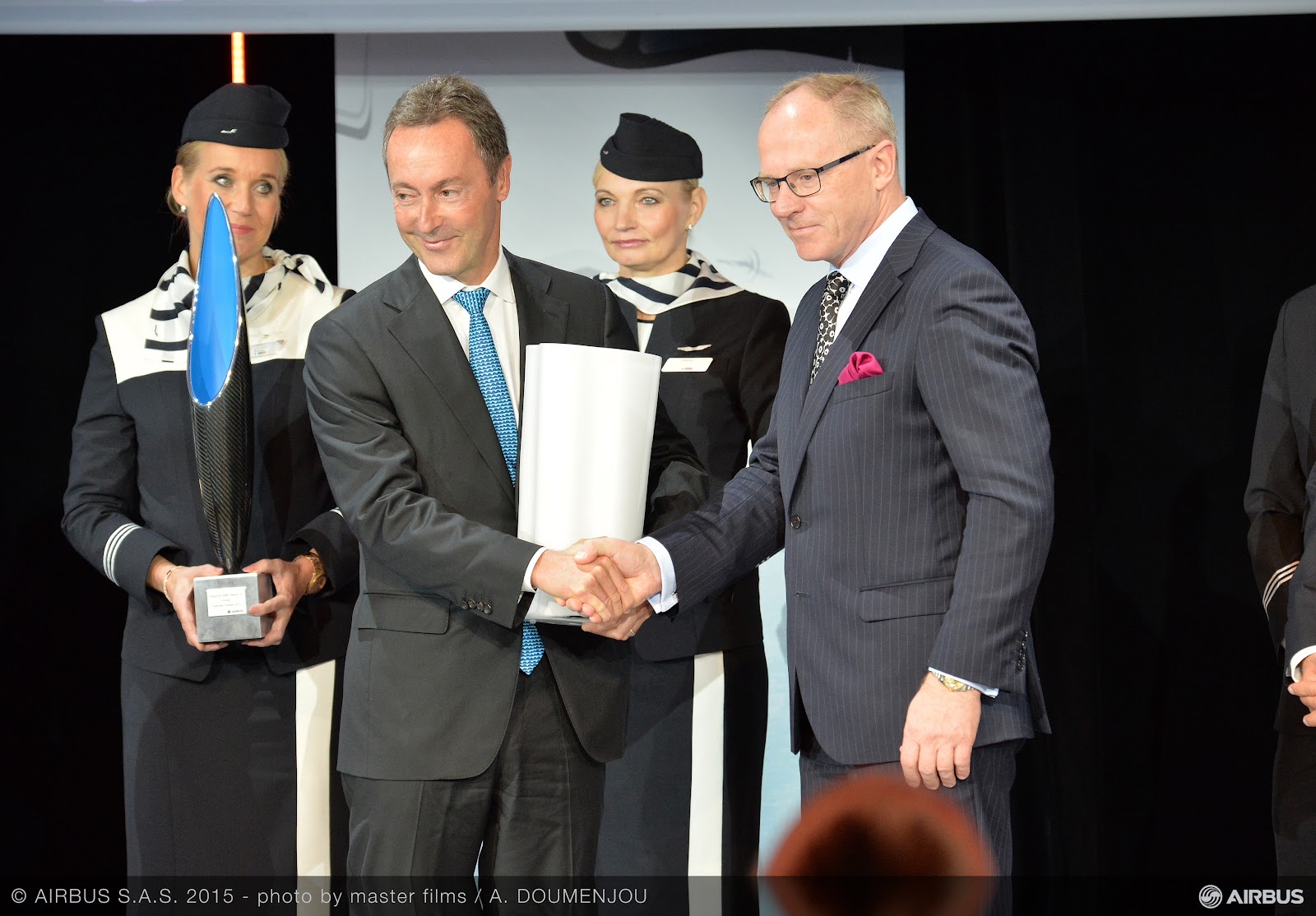
“Today heralds an exciting chapter in our history,” CEO Pekka Vauramo said. “The A350 XWB is the future of flying. This is the moment we have been waiting for.”
 
Source: Airbus
 

"At Airbus, we're proud and delighted to see Finnair, one of the world’s longest-standing and most respected airlines, become the first European carrier to fly the A350 XWB,”  said Fabrice Brégier, Airbus President and CEO.

“The A350 XWB's unrivalled fuel efficiency and passenger comfort make it the perfect aircraft to spearhead Finnair's Asian expansion.‎" 

“Ties between our 2 companies are becoming even stronger,” commented Fabrice Brégier. “I must thank Finnair for giving the A350 XWB such firm support.”
 
Source: Airbus
 

Eric Schulz, President - Civil Large Engines, Rolls-Royce, said: “We are very proud to be with Finnair and Airbus today to mark another chapter in the A350 XWB story.”

“The Trent XWB exemplifies how we take the best in technology to deliver new standards of excellence. Today marks the start of a new era in our relationship with Finnair and we look forward to working with them for many years to come.”
 
Source: Airbus
 

The airline became the first to commit to the type in 2007 with an order for 19 A350 900s.

The aircraft will form the backbone of Finnair’s long-haul fleet at a time of strategic importance for the airline. It has ambitious plans to double passenger numbers to Asia by 2020, making Helsinki Europe’s gateway to the Far East.

Source: Airbus

 
 “This is the beginning of a new era for Finnair,” said Maija Ignatius, Finnair’s A350 XWB Chief Purser.

“Everything is new and rethought for modern flying. I believe passengers can sense the excitement and pride as we work in the new airplane.

“I’m honoured to call the A350 XWB my work place. The experience of flying will be redefined!”

Source: Airbus


Based on the press release “Kiitos! Airbus says thank you to Finnair”


06 October 2015

Qatar starts installing inflight connectivity on their A350s.


A Qatar Airways Airbus A350, MSN42 currently in the FAL in Toulouse, has been equipped with Inmarsat Global Xpress inflight connectivity, the carrier’s GX integrator and value added reseller Thales confirms.


However, the airline is still deciding on a service provider.


Thales Inflyt Experience CEO Dominique Giannoni said, “We are on time in terms of installations; the first has been installed on the A350 frame and we are continuing our testing with Inmarsat and terminal unit provider Honeywell.”


Though Thales now has the infrastructure to support Qatar Airways as service provider for the program Giannoni revealed that a final decision has not yet been made by the airline.

 
All pictures. Source: Oliver Louis

Based on the article “Qatar faces user experience decisions as A350s get fitted with GX” published in Runway Girl Network.

05 October 2015

Airbus confident of 15 deliveries of A350 this year.


Airbus CEO Fabrice Brégier remains confident that the European aircraft manufacturer will achieve its goal to deliver around 15 Airbus A350 XWB aircraft this year.


“If we reach this target, I think we have secured a strong foundation for the future ramp-up of A350 production.”

Source: Airbus

“It is always extremely difficult to produce an aircraft that is just certified,” Bregier said.

Source: Alexander Hassenstein

There is a delay on the A350 deliveries since this summer mainly impacting to Qatar and also to Finnair that is going to be recovered before the end  of the year.

Source: Alexander Hassenstein
Total orders for the A350 XWB program stand at 782 orders from 40 customers.


Based on the article “Brégier: Airbus confident of A350 XWB delivery goal for 2015” published in ATWonline

04 October 2015

1st PEEK thermoplastic structural component in the A350.

Airbus Helicopters is replacing aluminum in a machined fitting in the aircraft passenger door of the Airbus A350-900 with a high-modulus, carbon fiber-reinforced high performance polymer.

The brackets, now manufactured from Victrex PEEK 90HMF40 has been developed by Airbus Helicopters in Donauwörth and is in serial production at Dutch Thermoplastic Components for commercial use after receiving the relevant component qualification.

Source: Victrex


The successful substitution of this metallic fitting has resulted in a 40% reduction in weight and costs.

The injection-molded polymer solution replaces the higher cost manufacture of the bracket machined from an aluminum block.


The fiber-reinforced polymer (FRP) structure of the A350 XWB’s aircraft door uses an outer skin coupled with a bracing structure on the inside.

This PEEK thermoplastic fitting connects the outer skin to points on the internal bracing structure.

The 2 components form a box-type support structure to exploit the maximum geometrical moment of inertia.


Optimized carbon fiber reinforced plastic (CFRP) drills improves the quality of the holes compared with the previous solution.


“This first application in the A350 is certain to be quickly followed by others”, explained Uwe Marburger, Aerospace Business Development Manager at UK-based Victrex.

The PEEK 90HMF40 is a high-performance polymer with high-modulus fibers (HMF). High strength components can be manufactured from this free flowing, easily processed material.

Its properties cannot be matched by those of the standard grades. For example, 90HMF40 has up to 100 times longer fatigue life and up to 20% greater specific strength and stiffness than aluminum 7075-T6 under the same conditions.


Based on the article “Primary structural component of A350 cabin doors are made with PEEK polymer” published in JEC Composites.

03 October 2015

Emirates decision between 787-10 and A350-900 postponed to 2016.

Emirates will not choose between the Airbus A350-900 or the Boeing 787-10 until next year, chief executive Tim Clark has confirmed.


There was a speculation that the Dubai air show next month might bring a high-profile order for one of the midsize widebodies from Emirates.

Clark has also ruled out a commitment at the show for more Airbus A380s, although he is still urging Toulouse to launch a revamped "A380neo" variant of the superjumbo.


Emirates has "all the data we need to make an assessment" of the baseline A350 and the stretched Dreamliner, although a decision is "not imminent", said Clark.

"It will be in 2016 – but when, I don't know – and it will be one or the other," he added.


Emirates cancelled its original order for 70 A350-900/1000s last year, but Clark says he is happy with revised performance numbers from Airbus, now that the -900 has entered service.


"We are now getting meaningful figures," he said. "The originals were just estimates."

Clark had also expressed concerns over the 787-10's hot-weather performance in the Gulf summer.


He said "there are still issues with the -10", but he maintains that Emirateshas been "testing it on paper" and is satisfied it could fulfil a role.

"We wouldn't put it on New York or Sydney, but as a workhorse up to 8.5h without a kink in the payload, it looks like a good aeroplane," he said.


Despite congestion at DXB, Clark said the new Dubai World Central, or Al Maktoum International, will not be ready for Emirates to relocate its passenger operations until the 2nd half of the 2020s.


Based on the article “Emirates to choose between A350-900 and 787-10 next year” published in Flight International.

02 October 2015

Significant positive impact for Finnair with A350 Enter Into Service.

As Finnair announced in Dec/2013, it has made sale & leaseback agreements for its 2 first A350 aircraft with GECAS (GE Capital Aviation Services).


These agreements will be concluded in connection with the delivery of the respective aircraft, and the value of the transaction is approximately EUR 260 million.

This sale & leaseback agreements for A350s, jointly with the phase out of all Finnair’s remaining A340-300s constitute a significant positive impact that calculated at present EUR/USD exchange rates is expected to be approximately EUR 70 million.


Source: Airbus


Finnair has ordered a total of 19 new A350-900 XWB aircraft, and under the target delivery schedule it will receive 4 aircraft until the end of this year, 7 in 2016–2017 and 8 in 2018–2023.


Finnair will dispose of the 7 A340-300 aircraft it currently operates by the end of 2017, replacing them as the A350s are delivered and enter into service on Finnair’s scheduled traffic routes.


Source: Jujug Spotting


Airbus has agreed to acquire 4 A340-300 aircraft currently owned by Finnair in 2016 and 2017.

Based on the article “Finnair expects to gain €70 million with the replacement of the Airbus A340-300s with new A350-900s” published in World airline news

01 October 2015

A350 carbon wing covers manufacturing technology changed: from ATL to AFP.


MTorres will provide the automatic fibre placement (AFP) machines that Airbus will use at its plants in Stade (Germany) and Illescas (Spain) to manufacture the A350 upper and lower wing covers.
Source: MTorres


Airbus has selected this technology change from its currently used MTorres made automatic tape laying (ATL) machines, to the latest generation of automatic fibre placement (AFP) machines, also developed by MTorres.


Source: Airbus


This change implies a substantial increase in the overall process productivity and a significant reduction on the material scrap generated in that process.


Source: Airbus


As a result relevant cost savings have been identified by Airbus leading to take this industrial decision, after going through all the technical analysis needed to validate this new technology for its application to these types of components.


Source: Airbus


The last generation AFP machines developed of MTorres includes an automatic head change capability, built in the AFP machines to carry out the head change within seconds, so that the process of replacing used carbon fibre spools for new ones has virtually no impact on the overall time the machine is laying down the material to build the part.


Source: Airbus


With this Airbus decision, all main A350 wing components, spars, stringers and skins will be manufactured using AFP technology, and MTorres is the sole supplier for these components AFP technology.


Based on the article “MTorres made AFP sole supplier for A350 wing skins” published in Aerospace Manufacturing